

See more with 3D dental imaging
CBCT cone beam imaging gives your dentist a detailed 3D view of your teeth, jawbone, and the structures around them. That extra detail can help your care team plan treatment with more confidence. At Desert Willow Dental in Glendale, we use CBCT to help plan dental implants, extractions, and other procedures.
Dr. Russell Crane and Dr. Amanda Pharo can explain what your images show in plain language, so you understand each step before it begins.
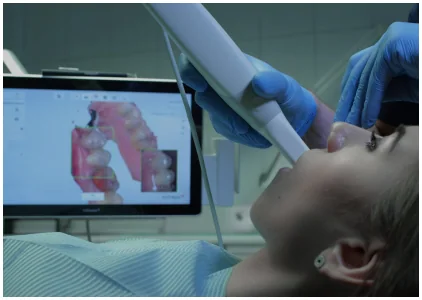
What is CBCT cone beam imaging?
CBCT stands for cone beam computed tomography. A traditional dental X-ray gives you a flat, two-dimensional picture. A CBCT scanner rotates around your head, captures many images, and builds them into a 3D view.
The scan is quick, typically under a minute, and generally uses a lower radiation dose than a medical CT scan. The images can show bone density, nerve pathways, tooth roots, and soft tissue.
Seeing these details from every angle helps your dentist check areas a flat X-ray may not fully show. CBCT also works alongside other digital tools in our office, including CEREC technology.
.webp)
When CBCT imaging is used
Your dentist may use CBCT imaging to support many types of care:
- Implant planning. See bone height, width, and nerve locations before dental implant restoration.
- Wisdom teeth evaluation. Check root position and nearby nerves before wisdom teeth removal.
- Tooth extraction planning. Understand root shape and surrounding bone before tooth extractions.
- Root canal diagnosis. Look for hidden canals or signs of infection that flat images can miss.
- Jaw joint evaluation. View the joints that connect your jaw to your skull.
- Airway assessment. Look at the open space in your nose and throat.
Not every patient needs a CBCT scan. Your dentist will recommend it when the added detail helps plan your care.
.webp)
What to expect during a CBCT scan
You will stand or sit while the machine slowly rotates around your head. You only need to hold still for a short time. The scan takes about 20 to 40 seconds.
There are no injections, and you should not feel any discomfort. Right after the scan, the 3D images are ready for your dentist to review with you. You can ask questions, see your own anatomy on screen, and talk through next steps together.
Benefits of CBCT imaging
Detailed 3D views
See teeth, roots, bone, nerves, and soft tissue from every angle.
Quick and comfortable
Most scans take about 20 to 40 seconds, with no injections.
Supports precise planning
Clear images help your dentist plan implants, extractions, and more.
Lower radiation than medical CT
CBCT typically uses a lower dose than a medical CT scan.